

The Hand-Finished Tibetan Singing Bowl for Your Daily Reset
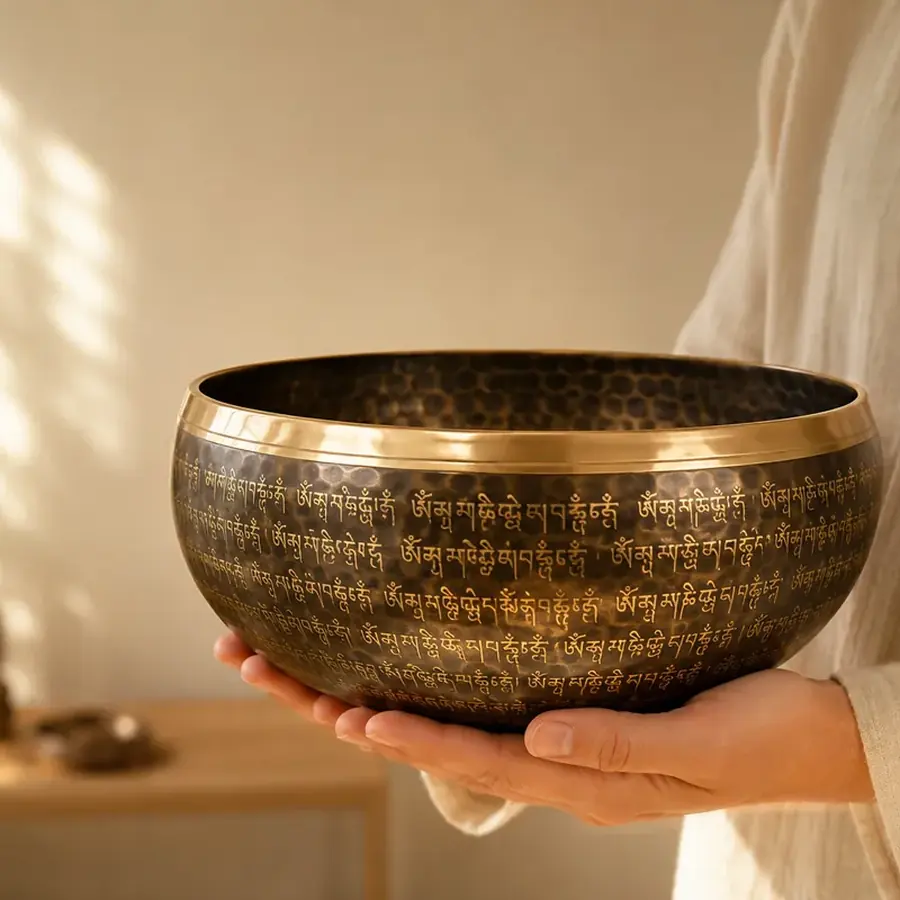
Strike the rim and get one clean, warm note that holds long after your shoulders drop. Hand-hammered brass with engraved mantras, in seven diameters from 3.1 to 6.7 inches, mallet and cushion included — an instrument for meditation, yoga and desk-side resets.
Complete set — bowl, silk cushion, 2-head mallet
🚨 Only a few left in stock
Why keep a singing bowl within arm's reach?
The appeal is not complicated. A Tibetan singing bowl is a struck instrument: a brass bowl whose walls vibrate when you tap the rim or circle it with a mallet. That vibration produces a tone you can both hear and, when the bowl rests on your palm, physically feel. Unlike a phone app or a playlist, it asks something small of you — a deliberate gesture — and that gesture is exactly what makes it work as a pause button. You cannot strike a bowl absent-mindedly. For those few seconds, you are doing one thing.
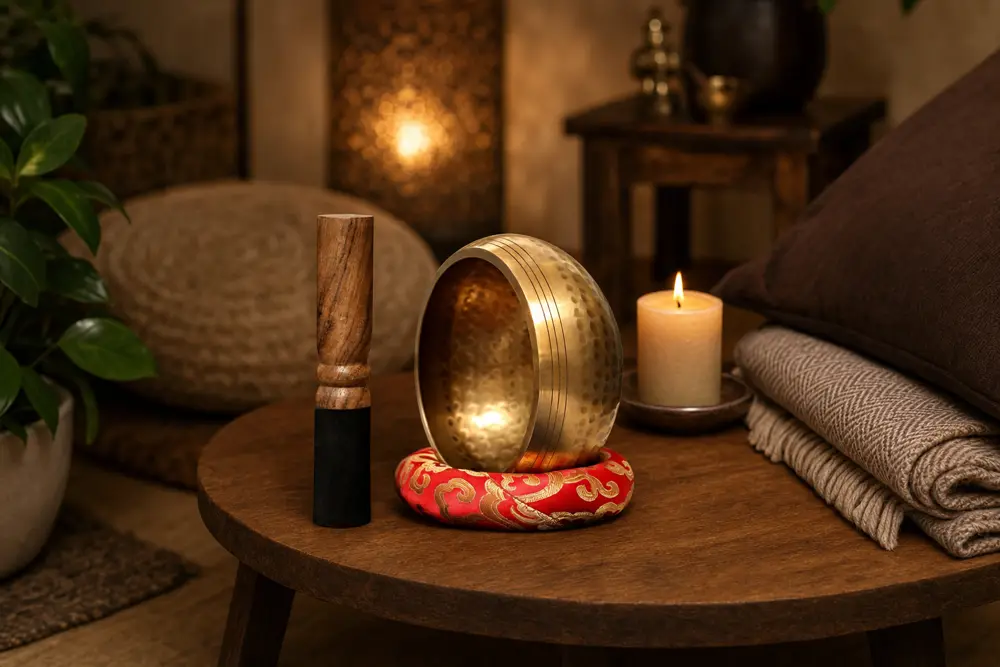
Buyers describe the same handful of habits over and over. A strike to open and close a morning sit, because the fading tone gives you a natural runway into silence — our singing bowl meditation guide walks through the full routine. A single note between video calls, the desk equivalent of stepping outside. A gentle rim circle during an evening wind-down, or as the opening note of a home sound bath built from nothing more than a candle, a cushion and twenty unhurried minutes. Yoga teachers use one note to gather a room; parents use it as a calmer signal than a raised voice.
What we promise is precise. This is hand-hammered brass with engraved mantras, in seven diameters from 3.1 to 6.7 inches, with a mallet and a cushion in the box, a real instrument at a fair price. It gives you one clear, warm note that holds for a surprisingly long time, and a reason to stop and listen until it is gone. For the deeper background on what a daily bowl habit does and does not do, our singing bowl benefits guide lays it out without the usual overclaiming.
One bowl, seven sizes, three reasons it earns its keep
A clear, long ringing voice
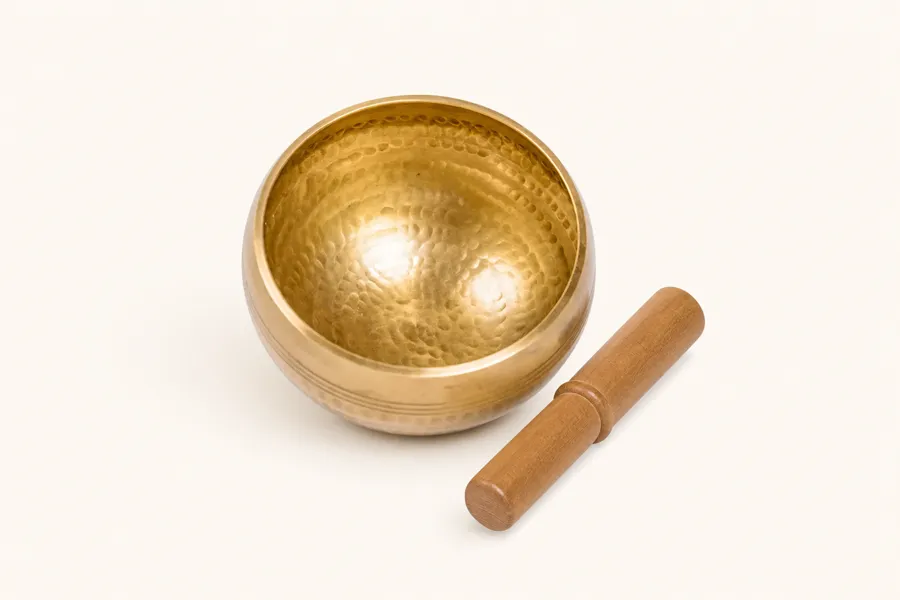
Strike the rim and the Nadam bowl answers with one clean, ringing note that fades slowly instead of dying flat. Verified buyers keep landing on the same phrase: "the sound is perfect," wrote one; "good purchase, good sound," wrote another. That voice is the whole point.
There are two ways to play it. Strike the outer rim with the included wooden mallet and you get the bell voice — bright attack, long warm decay. Rest the bowl on your flat palm, press the mallet against the rim and circle slowly, and friction builds the singing voice: a continuous hum that grows the longer you stay even. The narrower sizes speak quickly and clearly, which is exactly why they make a good first bowl: they respond without demanding perfect technique. Rim singing is a knack rather than a talent, and our step-by-step guide on how to use a singing bowl gets most people there in a single sitting.

Hammered brass, mantras engraved in gold
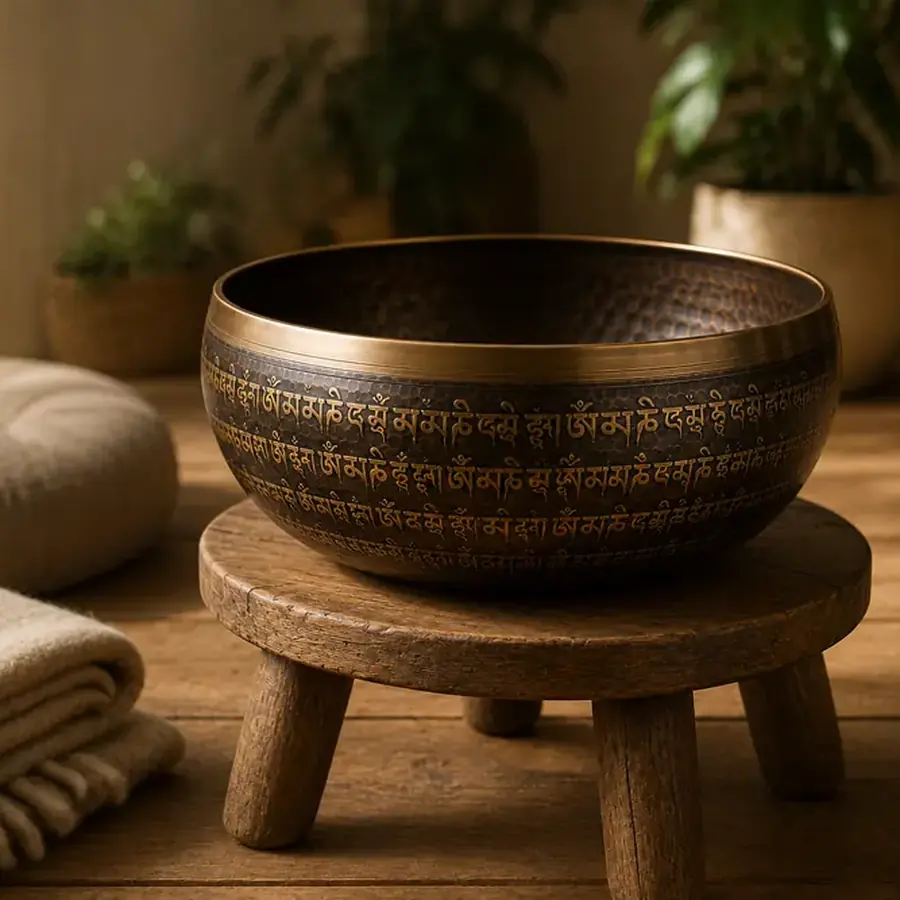
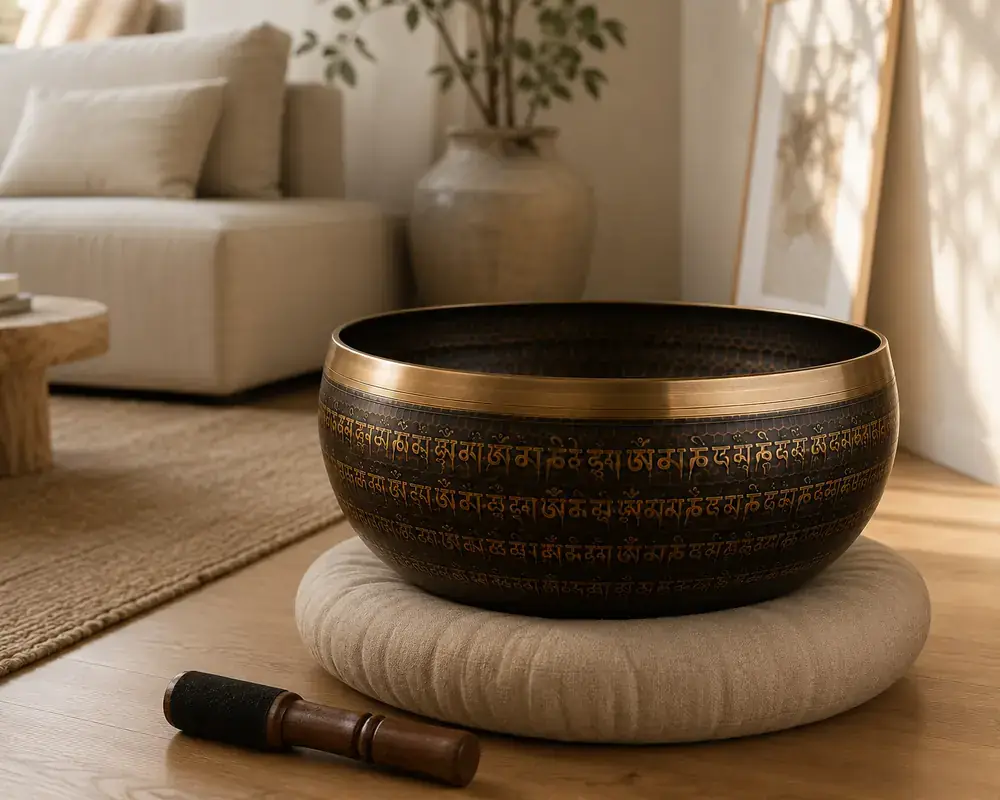
Every Nadam bowl is hammered brass, darkened, with rows of Tibetan mantras engraved in gold across the outer wall — and under them, hundreds of small dimples that catch light and scatter it softly. No two bowls wear exactly the same pattern, so the one on your shelf is recognizably yours, not one of ten thousand identical stamped pieces.
Look closely at the wall and you will see what defines this bowl: rows of shallow dimples worked across the brass, then hand-finished to a warm glow. The texture is not decoration for its own sake. It breaks up reflections, hides fingerprints and the small marks of daily use, and gives your fingers a grip a polished bowl never offers. It also means slight, honest variation from piece to piece — we consider that a feature, and we say so plainly. If you are curious how this approach compares with perfectly smooth, machine-made bowls, and why the two sound and age differently, we wrote a plain-English comparison of hand-hammered vs machine-made bowls.
Small enough to become a daily ritual
At 3.1 to 4.3 inches across, the smaller bowls live where your day happens — a desk, a nightstand, the corner of a yoga mat. Rituals survive when the tool is within reach: one strike before your first email, one slow rim circle before lights out.
Bigger bowls sound deeper, but they tend to live in closets. This one earns daily play by being frictionless: it weighs little, needs no stand, and the mallet nests inside it between sessions, so the whole ritual is grab, strike, breathe. Set it where a habit already lives — beside the kettle, on the meditation cushion, next to your monitor — and let the existing routine carry the new one. Our sound bath at home guide shows how to stretch this single small bowl into a full evening reset with nothing but a candle, a comfortable seat and twenty minutes.
How we test every singing bowl before it ships
Every listing on this site traces back to the same promise: every bowl in the catalog has been played by hand before it earned its place. Below is the bench check Mira runs on each model — the same five things you would check at a market stall, minus the airfare. It is deliberately low-tech: ears, hands, a cushion and patience.
| What we check | How Mira tests it | What earns a pass |
|---|---|---|
| Strike tone | Three strikes on the outer rim with the included wooden mallet — soft, medium, firm | One clean fundamental note at every pressure; no metallic slap, no buzz |
| Rim singing | Slow rim circles with both wooden and leather mallets until the hum stabilizes | The bowl catches within a few circles and holds a steady, even hum |
| Sustain | Strike once, then listen in a quiet room until the tone fully disappears | A long, gradual fade — the tone tapers instead of cutting off abruptly |
| Fit and finish | Rim run under the thumb, walls checked in raking light, engraving inspected on set bowls | Smooth rim, even hammered texture, crisp engraving lines, no sharp edges |
| Cushion seating | Played resting on the cushion that ships with it, and again on a bare palm | No rattle against the cushion; the tone stays open, never muffled |
What the numbers actually say
Average rating across 105 verified purchases of the 3.5 to 6.7 in bowls
— Verified buyer feedback, verified order history, 2026
The seven diameters we sell (8 to 17 cm) — from a bowl that rests in one palm to one that anchors a sound bath
— Nadam dimension sheet, 2026
Self-reported measures — tension, anger and fatigue — that eased after Tibetan singing bowl meditation in an observational study
— Goldsby et al., Journal of Evidence-Based Complementary & Alternative Medicine, 2017
Tibetan Singing Bowl vs. Singing Bowl Set vs. Leather Mallets
| Starter Set — 3.1 in | Larger Bowls — 3.5 to 6.7 in | Leather Mallets | |
|---|---|---|---|
| In the box | Engraved bowl + yellow silk cushion + 4.9 in two-head mallet | Bowl + leather mallet + cushion | One mallet — hardwood handle, leather head |
| Price | $39.95 (was $59.95) | $44.95–$114.95 by diameter | $14.95–$24.95 by size |
| Verified rating | 4.5/5 · 361 sold | 4.9/5 · 105 sold | 4.65/5 · 23 reviews |
| Finish | Flower of Life motif inside the base | Rows of engraved mantras on the outer wall | — |
| Best for | First bowl, desk resets, travel, gifting | Daily practice and sound baths | Warmer strikes, larger bowls |
| Read more | You're on it | Singing Bowl Set page | Mallet size guide |
One data point worth knowing before you pick a diameter: the widest bowl in the range measures 2.2 times the smallest across. That ratio is the whole story of the catalogue — it is what turns a bright desk note into a low hum you feel in your chest, and it is why the price climbs the way it does.
Small bowls get dismissed by people who have only heard big ones. A good 8 cm bowl does not try to fill a temple — it gives you one honest, present note at arm's length. That is what I listen for on every bowl we ship: a strike you will want to hear again tomorrow.— Mira Chandran, Sound practitioner & product lead at Nadam
Choose your singing bowl setup
Free shipping (6–10 business days) · 30-day money-back guarantee
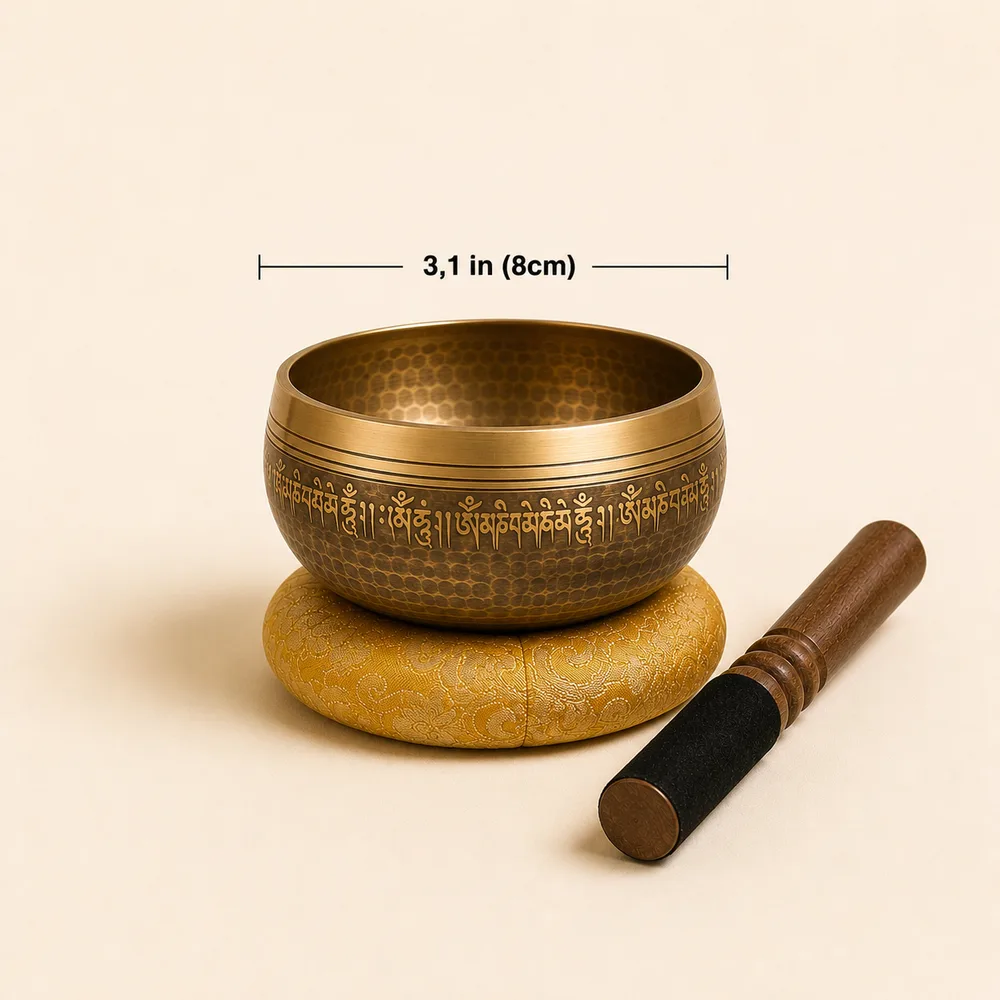
Starter Set — 3.1 in (8 cm)
Engraved 3.1 in bowl · silk cushion · 4.9 in two-head mallet. The complete, gift-ready kit.
You save $20
Free shipping · Ships in 6–10 business days
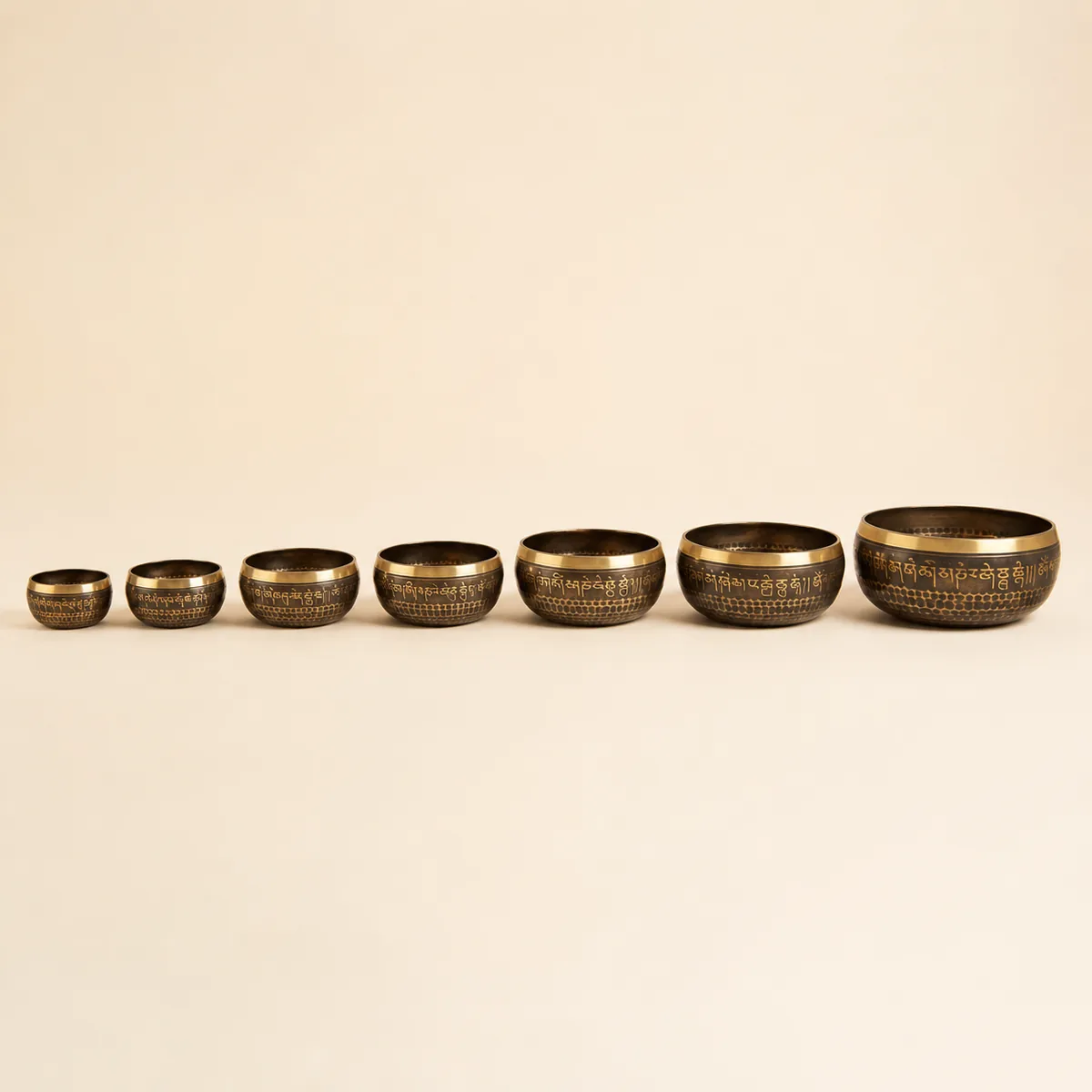
Larger Bowls — 3.5 to 6.7 in
The wider the bowl, the lower and longer it sings. Six diameters from 3.5 in (9 cm) to 6.7 in (17 cm), each with its leather mallet and cushion.
You save $20 on every size
Choose My SizeCushion included, hand-paired with your bowl
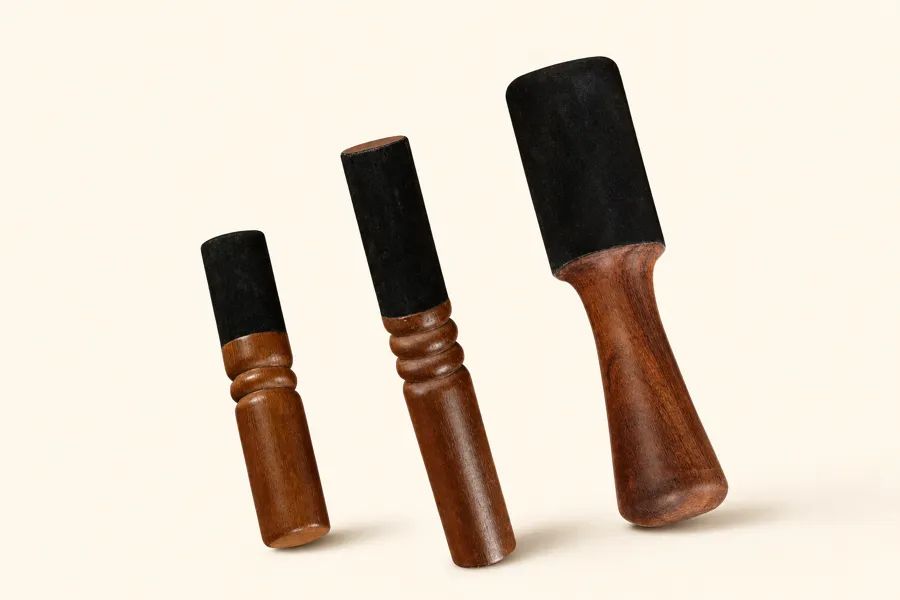
Leather Mallets
Hardwood handle, stitched leather head. Three sizes for brighter or deeper strikes.
Small fits the 8-11 cm bowls
·
Not sure? Read the mallet size guide
🔒 Secure Stripe checkout · Cards & Apple Pay accepted · 30-day money-back guarantee
Buying guide: your first Tibetan singing bowl
How to choose a singing bowl (and what to skip)
Choose by ear and by habit, not by mystique: a small 8 cm bowl for desks, travel and daily strikes; the engraved set if you want cushion, mallet and gift-ready presentation in one box; a leather mallet to soften and deepen the strike tone of any bowl you own.
Size first — and be honest about where it will live. Bowl diameter is the biggest single choice. Larger bowls speak deeper and sustain longer, but they need a dedicated spot, a bigger budget and usually two hands. The 8 cm format wins on a different axis: it sits on a desk, slips into a carry-on, plays one-handed and — because rituals live or die on convenience — actually gets used every day. If you are weighing the trade-offs, our guide to choosing between a large and small singing bowl goes deeper, with honest pros and cons for each.
Then the finish. Every Nadam bowl is hand-hammered, so the wall carries the dimpled field the hammer leaves behind. The 3.1 in starter bowl adds a Flower of Life motif inside its base; the larger sizes carry rows of Tibetan mantras engraved in gold across a darkened outer wall. Whichever you pick, the box answers the two questions every new owner eventually asks — what do I rest it on, and is my mallet right? — because the cushion and the mallet are already in it.
Match the mallet to the sound you want. The included mallet gives a bright, direct strike. A leather head softens the attack and warms the tone — most owners end up wanting both, the way a photographer wants two lenses. Sizes matter: the small 5.1 in (13 cm) leather mallet suits the 3.1 to 4.3 in bowls; the 7.1 in (18 cm) medium is the all-rounder; the 7.1 in large head, with its wider 1.6 in face, is built for the 5.9 and 6.7 in bowls and their deeper strike tones. The comparison table above routes you to the right one.
What to skip. Be wary of bowls marketed with precise healing frequencies or medical promises. No Nadam bowl carries a frequency chart, because hand-hammered walls each hold their own voice, and that individual voice is the whole point of buying hammered brass. Look instead at what you can verify: the depth of the hammer work, the engraving, the weight in your hand, and the guarantee behind it. That is where a bowl either earns its price or does not.
What you can hold us to. Every model is played before it earns a listing — strike, rim, sustain, finish — because that is the standard we built Nadam around; the story is on our about page. If your bowl arrives and the voice is not what you hoped for, the 30-day money-back guarantee applies. Free shipping, 6–10 business days, tracking included.
Specifications
| Bowl diameters | 3.1 · 3.5 · 4.3 · 4.9 · 5.3 · 5.9 · 6.7 in (8 · 9 · 11 · 12.4 · 13.4 · 15 · 17 cm) |
| Material | Hammered brass, darkened, with Tibetan mantras engraved in gold |
| In every box | Bowl · cushion · mallet |
| The 3.1 in starter set | Flower of Life engraved bowl · yellow silk cushion · 4.9 in (12.5 cm) two-head wood and leather mallet |
| The 3.5 to 6.7 in bowls | Bowl · leather mallet · cushion. Each piece is finished by hand, so your cushion pairing and the motif struck inside the base belong to your bowl alone |
| Leather mallet sizes | Small 5.1 × 1 in (5.1 × 1 in) · Medium 7.1 × 1 in (7.1 × 1 in) · Large head 7.1 × 1.6 in (7.1 × 1.6 in) |
| Shipping | Free shipping, 6–10 business days — full details in our shipping policy |
| Returns | 30-day money-back guarantee — see the refund policy |
| Checkout | Secure Stripe checkout — cards & Apple Pay |
All dimensions come from the spec sheet diagrams, not tape-measure guesses. Unsure whether it fits your shelf or an existing cushion? Contact us — we are happy to measure before you order.
Rated 4.9 / 5 across 105 verified purchases
"I bought the 17 cm size. Very good sound. If you just circle it, the sound appears on its own, without even striking the bowl. The small raised marks inside the bowl increase the vibrations even more. One of the best bowls."
— Verified buyer
"Excellent bowl, I am very happy with it, it sounds good, fast delivery, under two weeks, well packaged. Completely satisfied with the product. I recommend it."
— Verified buyer
"A very good stick! The edges are very even, the seam is very well done, with no bulges. The wood is heavy, just right! Good sound. Very pleased!"
— Verified buyer · included mallet
Photos from verified buyers. See our reviews page for more.

Mira Chandran · Sound practitioner & product lead at Nadam
Mira has been leading small-group sound baths for years. She plays every size Nadam sells — strike tone, rim singing, sustain, how the bowl sits on its cushion — before that model earns a place in the catalog.
Reviewed and updated July 4, 2026. See how we test.
Tibetan singing bowl questions, answered plainly
What is a Tibetan singing bowl used for?
A Tibetan singing bowl is a brass instrument played by striking the rim or circling it with a mallet. Most owners use the tone to open or close meditation, mark the start of yoga practice, run a short sound bath at home, or simply pause during a stressful day. Many practitioners value it for relaxation and focus. It is an instrument, not a medical device.
Tibetan or crystal singing bowl?
They are two different instruments. Hammered brass rings with overtones stacked over a fundamental note, so one strike gives a warm, complex voice that fades over a long tail — and because the bowl rests in your palm while it rings, you feel that vibration through your hand. Quartz, a different material, holds one sustained tone instead of that layered voice. Every bowl on this page is hammered brass.
How do I make a singing bowl sing?
Rest the bowl on your flat palm, strike the rim once, then press the mallet against the outside edge and circle with slow, even pressure. Friction builds a continuous hum that grows as you stay steady. Expect a few minutes of practice: circling too fast causes rattle, pressing too lightly loses the tone. Our how-to guide covers both strike and rim techniques step by step.
What sizes do you sell, and is a mallet included?
Seven diameters: 3.1, 3.5, 4.3, 4.9, 5.3, 5.9 and 6.7 inches (8 to 17 cm). Every bowl ships with its mallet and a cushion, so you can play it the day it arrives. The 3.1 in starter set comes with a yellow silk cushion and a 4.9 in two-head mallet; the larger sizes come with a leather mallet and a silk cushion paired by hand with your bowl.
Which size should I choose?
Diameter sets the voice. Smaller bowls answer the mallet instantly with a bright, clear note and sit easily on a desk. Wider bowls take a beat to bloom, then hold a lower, longer hum that fills a room. If you want one bowl for daily meditation, most people land between 4.3 and 5.3 inches. Go to 5.9 or 6.7 inches for sound baths.
Which leather mallet size should I choose?
Small (5.1 × 1 in) suits the 3.1, 3.5 and 4.3 in bowls. Medium (7.1 × 1 in) is the versatile pick if you play several sizes. The large head (7.1 × 1.6 in) favors the 5.9 and 6.7 in bowls and deeper strike tones. All three combine a hardwood handle with a stitched leather head.
Do singing bowls actually help you relax?
We keep claims careful. An observational study published in the Journal of Evidence-Based Complementary & Alternative Medicine (Goldsby et al., 2017) reported reduced tension, anger and fatigue after Tibetan singing bowl meditation sessions. Many practitioners build bowls into relaxation and mindfulness routines. A singing bowl is not a medical treatment, and we never sell it as one.
Why are singing bowls so expensive?
Price follows hand work and metal. Each wall is hammered dimple by dimple, darkened, then engraved with mantras in gold — hours a press never spends. Wider bowls take more brass and more hammering, which is why the range climbs with diameter. Every model is played on the bench before it earns a listing, and the mallet and cushion are already in the box. Our hand-hammered vs machine-made guide shows where those hours go.
How much does a singing bowl cost?
Cost tracks diameter and what comes in the box. The 3.1 in starter set is the entry point, and the price climbs step by step through the seven sizes as the bowls grow wider and sing lower. Current prices for every diameter, and for the leather mallets, are listed in the Choose your singing bowl setup section on this page. Shipping is free and the 30-day guarantee applies to all of them.
How long does shipping take, and where do you ship?
Every order ships free to the United States, Canada, the United Kingdom, Australia, New Zealand, Ireland and most of Western Europe. US orders typically arrive within 6–10 business days, tracking included; international delivery can take a little longer. Current timelines by destination are always listed on our shipping policy page, and your confirmation email carries the tracking link.
What if the bowl is not right for me?
Every Nadam order carries a 30-day money-back guarantee. If the bowl does not sound or feel the way you hoped, contact us within 30 days of delivery and we will walk you through the return — no interrogation. Checkout runs on Stripe, so your card details stay encrypted and never touch our servers.
One strike. One long, clear note. Then quiet.
The 8 cm hand-finished Nadam bowl ships free with its wooden mallet — $39.95, backed by a 30-day money-back guarantee.
Get My Bowl — $39.95 →🚨 Only a few left in stock