
· Mira Chandran
Singing Bowl Benefits: What We Actually Know
Type "singing bowl benefits" into a search engine and you meet a wall of confident promises: cured insomnia, dissolved anxiety, organs retuned by precise frequencies. Most of those pages overreach, and some are simply making things up. The real picture is smaller and, we think, far more useful. The research on Tibetan singing bowl benefits amounts to one carefully framed study worth knowing, a set of effects people report consistently, and a few ordinary mechanisms that explain why a small brass bowl can change the texture of an evening. This guide walks through all of it — and is just as clear about the claims you will never read on this site.

What the research actually says
The study we cite — the only one we cite — followed people attending Tibetan singing bowl meditation sessions and recorded how they said they felt. After the sessions, participants reported reduced tension, reduced anger and reduced fatigue. Notice the verb: reported. These are people describing their own state, not a lab instrument printing a readout, and we will keep that word attached to every claim in this article.
Read the finding with both eyes open. "Observational" means there was no randomized comparison group, so the study cannot separate the bowl itself from everything that travels with it: a quiet room, permission to lie still, the expectation that relaxation is coming. None of that makes the result worthless. It makes it exactly what it is — an early, encouraging signal that a low-cost, low-risk practice leaves many people feeling noticeably calmer by their own account.
Year an observational study reported reduced tension, anger and fatigue after Tibetan singing bowl meditation sessions
— Goldsby et al., Journal of Evidence-Based Complementary & Alternative Medicine, 2017
Why cite only one study? Because the wider literature on sound practices is thin, uneven in quality and easy to misquote. We would rather hand you one paper described accurately than ten described generously. If stronger evidence arrives, we will update this page — in either direction.
Why a bowl session feels good: three ordinary mechanisms
It gives attention one thing to do. Most people who say they "can't meditate" are fighting silence. A struck bowl replaces silence with a single warm tone that slowly fades, and following that fade to its very end is a task simple enough that a restless mind will actually do it. When the sound ends, you strike again. That is the whole practice.
It paces the breath without instructions. A long, decaying tone invites a long, decaying exhale. Nobody counts for you and no app chirps at you; the sustain does the pacing on its own. Slow exhales are a fixture of nearly every relaxation practice for good reason.
It draws a line in the day. A bowl is a physical object with exactly one job. Picking up the mallet is a signal — to yourself and to the household — that screens are done and the evening has changed gears. Rituals work partly because they are unambiguous.
"I never tell a guest the bowl will fix anything. I tell them it gives the mind one warm, fading sound to rest on. For most people, that is enough to slow an evening down."— Mira Chandran, sound practitioner and product lead at Nadam
Reported benefits vs. what we refuse to promise
This is the scorecard we would want as buyers, so it is the one we publish as sellers. Every row follows the same rule we apply across the whole catalog: describe, never diagnose.
| Claim you will see online | Where it actually stands | Our position at Nadam |
|---|---|---|
| Deeper relaxation, lower felt tension | Reported in an observational study (Goldsby et al., 2017); the most consistent theme in buyer feedback | We stand behind it, phrased as what it is: a relaxation practice |
| Calmer mood after a session | Participants in the same 2017 study reported less anger and fatigue | Fair to expect; strength varies person to person |
| Easier wind-down before sleep | Common user report; no formal sleep evidence we know of | We call it an evening ritual, never a sleep aid |
| Cleaner breaks from screens, steadier focus | Practice-based; many practitioners open and close focus blocks with a strike | A reasonable use; the effect is subjective |
| Treats anxiety, insomnia or pain | A medical claim with no clinical backing | Refused. Talk to a healthcare professional about health concerns |
| Specific frequencies heal organs or chakras | No supporting evidence | Refused. We publish no frequency figures anywhere on this site |
That last row matters more than it looks. You will not find a frequency figure on any Nadam page, because we have no verified measurement to give you — and a spec nobody measured is not a spec, it is decoration.
Three concrete ways to use a singing bowl
1. The ten-minute evening wind-down
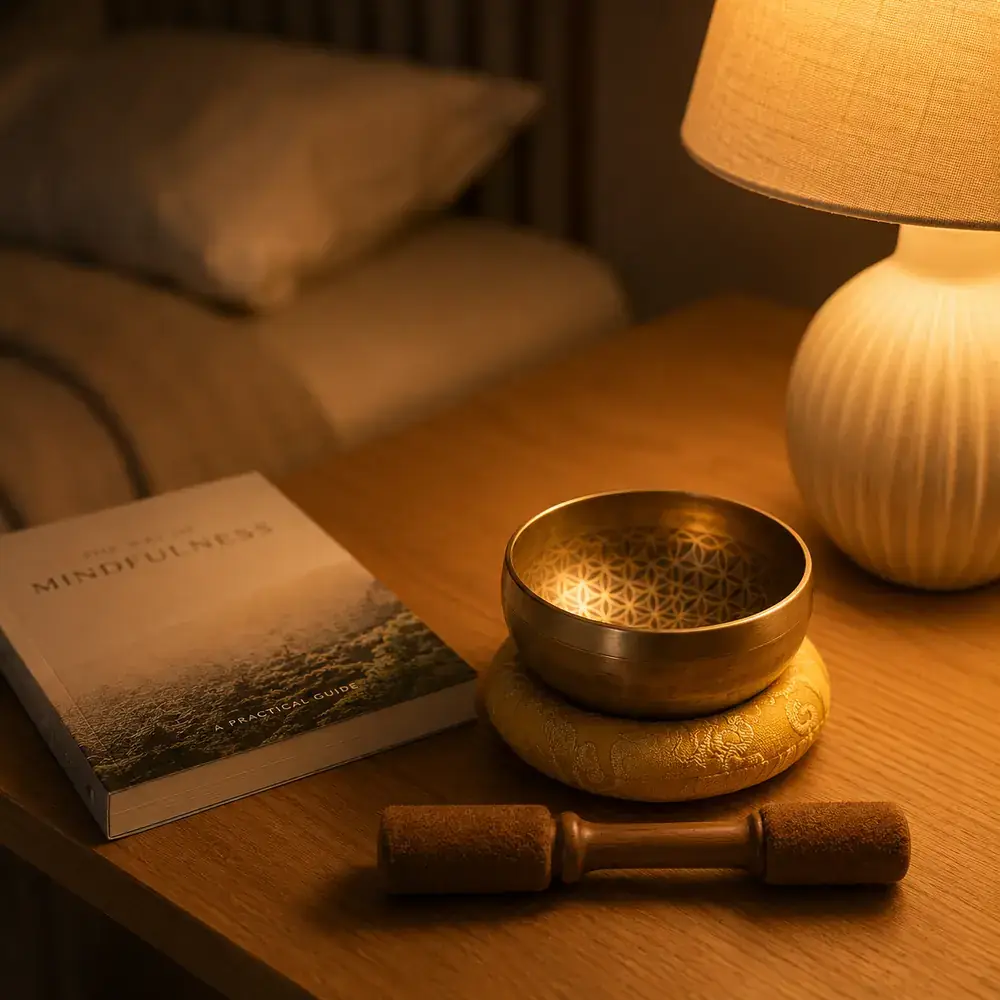
Sit somewhere you will not be interrupted, rest the bowl on your flat palm or its cushion, and strike the rim gently. Listen until the tone has completely gone — not mostly gone, completely — then strike again. Ten minutes of this on most evenings beats one heroic hour on a random Sunday. If the technique is new to you, our guide on how to strike and ring a singing bowl properly covers grip, strike angle and rim singing.
2. The screen break that actually breaks
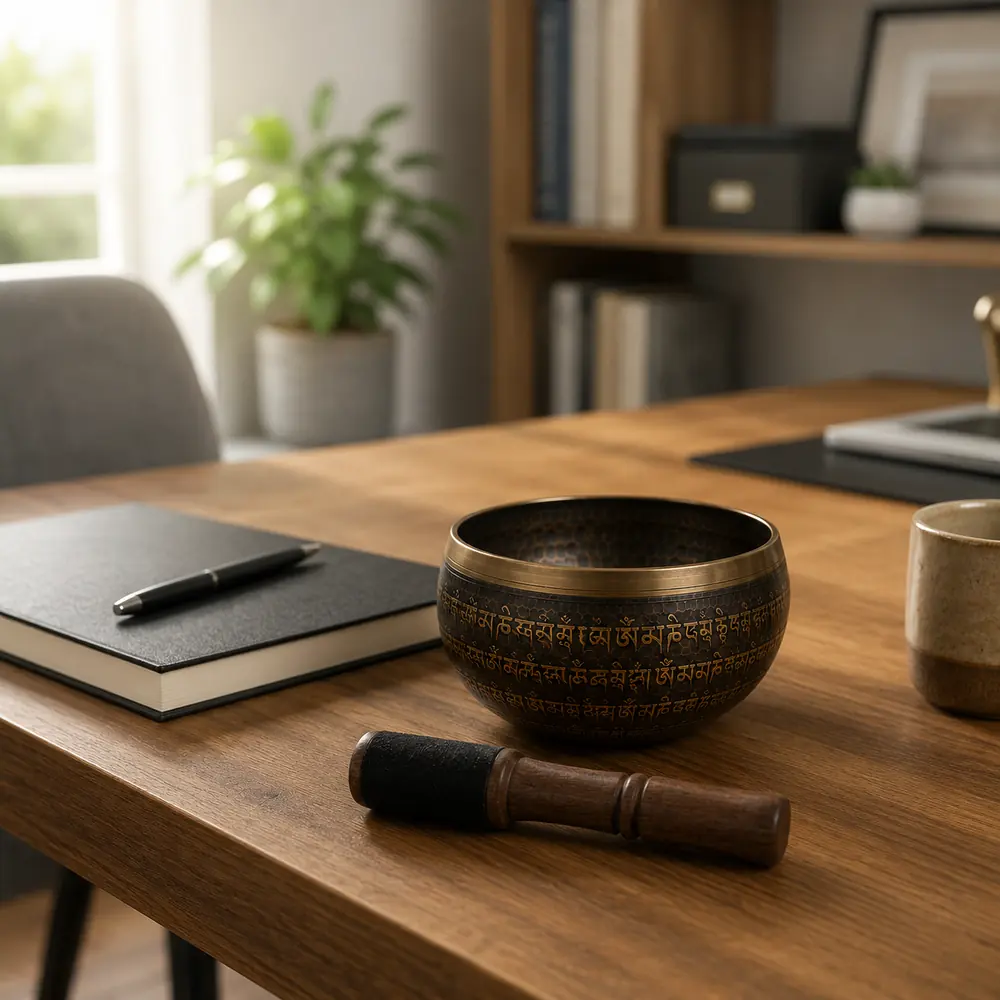
Keep the bowl on your desk. When you close the laptop — lunch, end of day, between long calls — give it one strike and stay put until the room is silent again before you stand up. The point is not mystical: it is a hard boundary your attention can feel, instead of the usual slide from one glowing rectangle to another.
3. A frame for breathing practice
Use one strike to open and one to close, and breathe slowly in between. The fading tone hands your first exhale its cue, and the closing strike keeps the session from trailing off vaguely. Our step-by-step singing bowl meditation guide has a full routine to follow, and if you want to scale the ritual up for two or three people, here is how to set up a small sound bath at home.
Diameter of our smallest bowl (8 cm) — small enough to rest on one palm for any of these routines, and the range runs up to 6.7 in
— Nadam dimension sheet, 2026
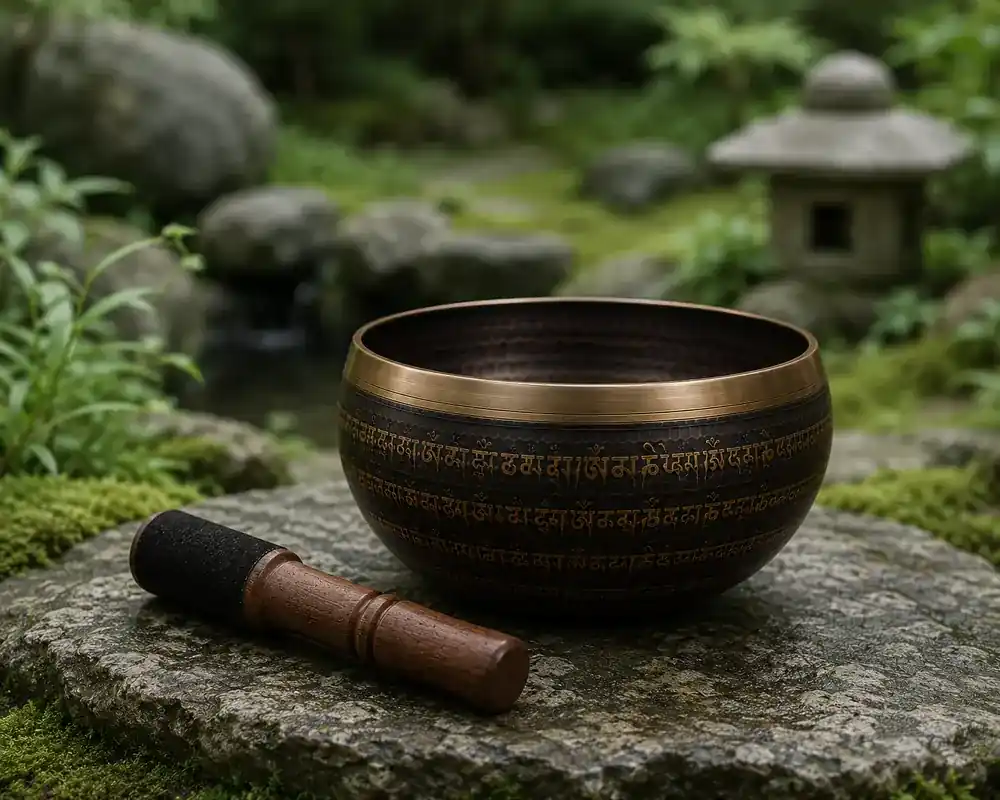
None of these routines calls for a gong the size of a dinner table. The Tibetan singing bowls we sell are hammered brass with engraved mantras, ship with a mallet and a cushion, and cover all three uses on their own — at any of the seven diameters.
Does the bowl itself change the benefits?
Size changes pitch and handling — smaller bowls sit in the palm with a brighter voice, larger ones live on a cushion with a deeper hum — and our comparison of large vs. small singing bowls walks through the trade-offs. Construction shapes character too: hand-hammered and machine-made bowls differ in surface and voice. And the striker matters more than most people expect: a leather head draws a softer, rounder tone from the same bowl than bare wood, which is why we stock leather mallets in three sizes, from a 5.1 in small up to a 7.1 in wide-head.
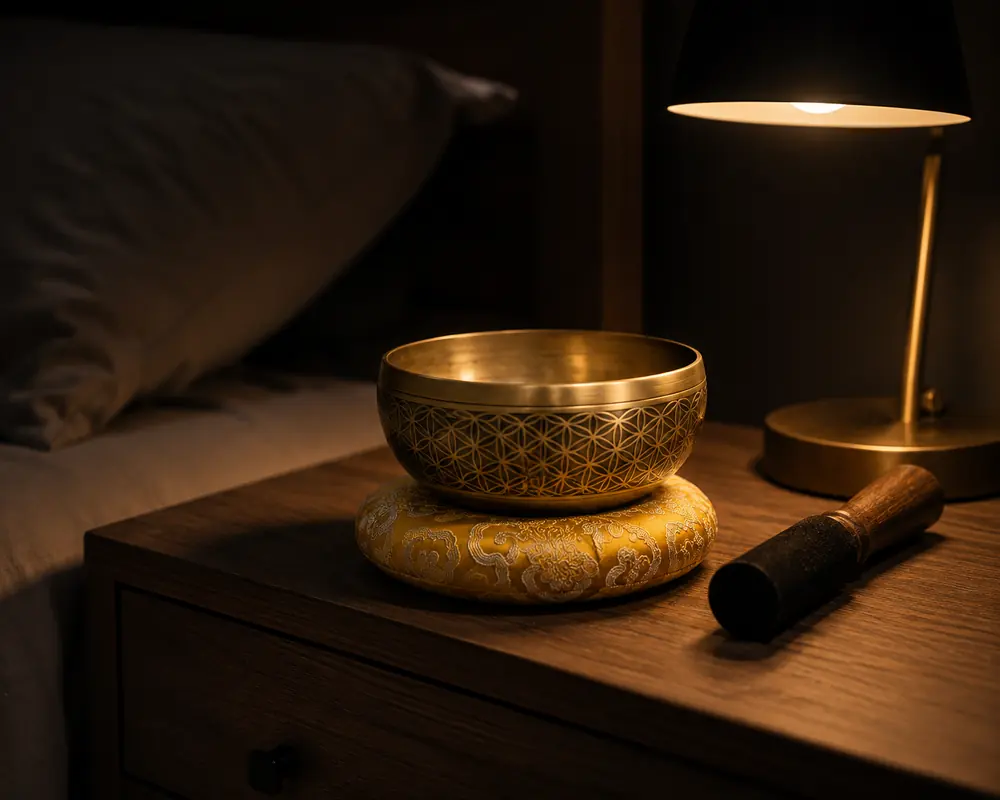
If you want the full ritual in one box, the 3.1 in starter set pairs an engraved bowl with a yellow silk cushion and a 4.9 in dual-ended mallet — wood on one end, leather on the other — and you choose your diameter on the product page. The starter set holds 4.5/5 across 361 verified purchases and the mallets hold 4.65/5 across 23; you can read the verified reviews behind those figures yourself.
Average rating across 105 verified purchases of the 3.5 to 6.7 in bowls
— Nadam verified order history, 2026
Whatever you pick, the hierarchy is simple: a bowl you will use daily beats a bowl that photographs well. Mira plays every bowl before it enters the catalog — strike tone, rim response, sustain, how it sits on its cushion — and how we test lays out the whole process.
Where a singing bowl earns its place
We built Nadam on a simple bet: buyers prefer a seller who says "here is what a bowl does, and here is what we do not know." You can read more about who is behind Nadam if that approach speaks to you. Every order ships with free shipping (6-10 business days), is covered by a 30-day money-back guarantee, and checks out through secure Stripe payment — so trying the ten-minute evening routine carries exactly as much risk as the research does: very little, with a fair chance you end up calmer.

Mira Chandran · Sound practitioner & product lead at Nadam
Mira has been leading small-group sound baths for years. She plays every size Nadam sells — strike tone, rim singing, sustain, how the bowl sits on its cushion — before that model earns a place in the catalog.