
· Mira Chandran
How to Clean a Singing Bowl Without Killing the Patina
Search this question and you will meet the same three suggestions inside a minute: a paste of lemon juice and salt, a splash of white vinegar, or the tin of metal polish under the sink. All three work exactly as advertised, and that is the problem. They take brass back to bright, bare metal, which is right for a doorknob and wrong for a bowl whose entire appearance is a dark wall with gold mantras cut into it.
What patina actually means on a singing bowl
On a Nadam bowl the dark wall is not age and it is not neglect. It is the finish, applied on purpose: hammered brass, darkened, with rows of Tibetan mantras engraved in gold, the wording on our Tibetan singing bowl page. Polish it and nothing better appears underneath. You remove the darkening, thin the gold sitting in the engraved lines, and end up with a shiny bowl carrying the ghost of a pattern.
The second kind arrives on its own: skin oil from the palm you rest it on, a duller band where the mallet travels the rim, colour deepening inside the hammered dimples. That takes years, and it is the only part of the surface that is genuinely yours.
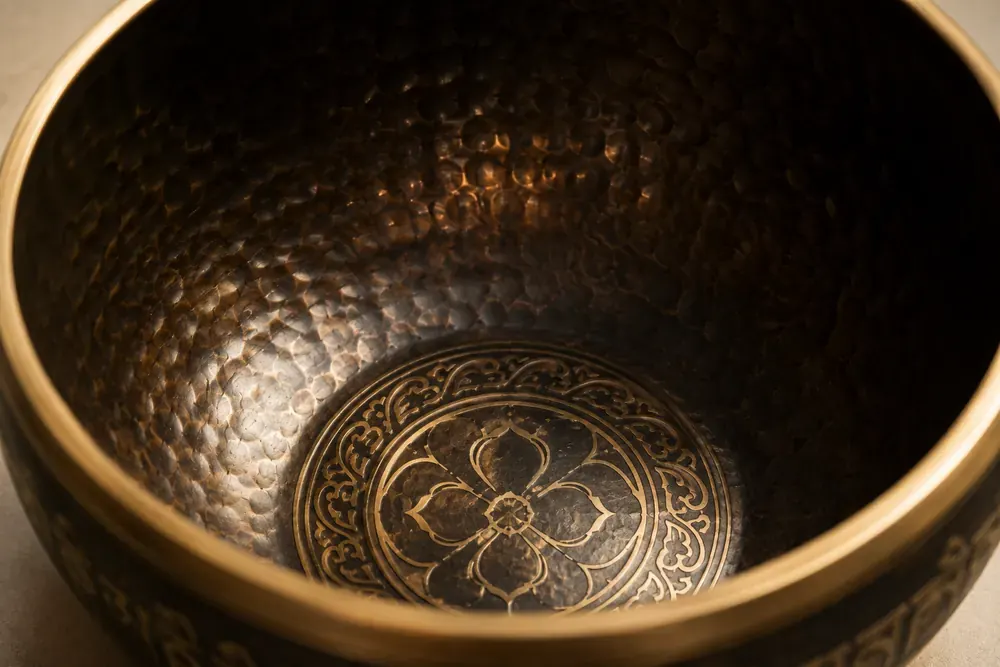
We publish what our own bowls are made of, because we can check it: brass, hammered, darkened. I cannot tell you what yours is made of or how old it is, and neither can anyone working from a photograph. We refuse to invent that kind of provenance for our own catalog, as our about page spells out. It matters, because every aggressive method quietly assumes you know what you are attacking. Why the wall is dimpled at all is answered in hand-hammered vs machine-made singing bowls.
The dry routine that covers almost every bowl
A folded cotton t-shirt does this as well as anything sold for the purpose. Work the cloth into the hammered dimples inside, then the outside. Rim last, always, because it is the one surface where a smear costs you something audible.
If you keep the mallet inside the bowl between sessions, the dry wipe matters more rather than less: leather and wood resting against a darkened wall for months leave marks that lift off easily in week one and stubbornly in month six.
When water is fine, and how not to leave a mark
Wash when something has landed on the metal: candle wax, a splash of tea, the sticky halo an incense holder leaves behind. Not on a schedule, and not because the wall looks darker than it did last year.
Never soak it, because water that creeps into the engraved lines or under the base is what dries into rings. Dry it properly, meaning a dry cloth immediately and then twenty minutes on a folded towel. Almost every water mark people write to us about came from the drying, not the washing. If your tap leaves spots on glassware, it will leave them on brass.
What actually dirties a singing bowl
Incense smoke and a burning candle deposit residue on whatever cold surface is nearest, and that is usually the bowl. If your corner runs on candles and incense, and our guide to setting up a sound bath at home suggests precisely that, put the dry wipe at the end of the session instead of the end of the month.
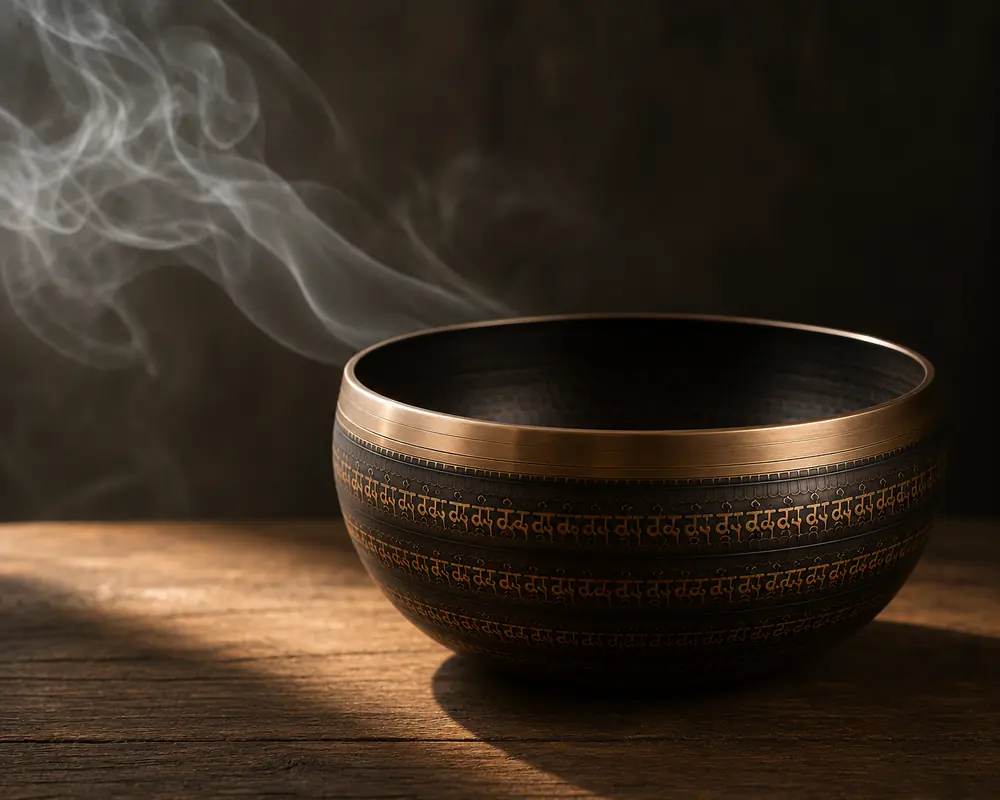
A bowl on an open kitchen shelf collects airborne cooking grease, and grease does not come off dry. That is the one case where a drop of dish soap earns its place early rather than late.
The seven diameters we sell (8 to 17 cm). Every one leaves the workshop darkened rather than polished, so a bright finish is not the target on any size
— Nadam dimension sheet, 2026
What you should never put on a singing bowl
Conservation guidance for brass and copper says it in flatter language: polishing is an abrasive operation that removes tarnish and some surface metal, and repeated polishing results in a loss of surface detail. On a bowl whose value is a dark wall with fine engraved lines, the surface detail is the product.
Canadian Conservation Institute note stating that polishing removes tarnish and some surface metal, and that repeated polishing results in loss of surface detail
| Recommended online | What it does to a darkened bowl | Instead |
|---|---|---|
| Metal polish of any kind | Lightens the wall unevenly in one pass and lifts gold out of the engraved lines | Dry cloth |
| Lemon and salt paste | Acid plus abrasive at once: brightens the brass and takes the darkening with it | Warm water, one drop of mild soap |
| White vinegar or ketchup | Attacks the surface unevenly, leaving patchy bright spots you cannot blend back | Nothing. A film is not damage |
| Baking soda paste | Mild abrasive that scratches the wall and dulls the polished rim | Soft cloth, no product |
| Scouring pad or wire wool | Permanent scratch pattern across the hammered texture | Cotton or microfibre only |
| Dishwasher | Hot detergent over a long wet cycle dulls the finish and dries marks into the engraving | Wipe by hand, dry at once |
One more suggestion sounds helpful and is not: sealing the bowl under a wax or a lacquer. Coatings belong on collection pieces nobody touches, and a bowl is handled and struck by definition. Rim singing runs on friction between bare metal and the mallet, so the rim is the last surface here you want to add a layer to.
If the bowl might be old, stop before you clean anything
Our own bowls are new pieces, hammered, darkened and engraved by hand, which is exactly why you can clean one without fear. An inherited bowl is a different question: nobody can date a bowl, read its alloy or price it from a photograph, and anyone offering to do all three is guessing at your expense.
On collected metalwork the patina is generally treated as part of the object rather than dirt sitting on it, and a freshly brightened surface is often the first thing that makes a serious buyer walk away. Photograph the bowl as it is, leave it alone, and take it to an appraiser or a conservator first. Two signals mean hands off entirely: powdery pale green spots that keep returning after you brush them away, and any flaking of the metal itself.
Does a clean bowl sound different?
A layer of dust on a brass wall does not detune anything you can hear. If your bowl sounded good in March and dull in October, the likelier suspects are the mallet, the cushion, or where your fingers are sitting, and our guide on how to use a singing bowl works through all three. The rim is the real exception: rim singing runs on friction. Put skin oil in the middle of that and the mallet skates.
You will not find frequency charts here, before cleaning or after, because every hand-hammered wall holds its own voice and that is the point of buying one, a position we set out on our testing page. It is also why no polish will ever return a bowl to a note it never had.
The cushion, the mallet and the shelf it lives on
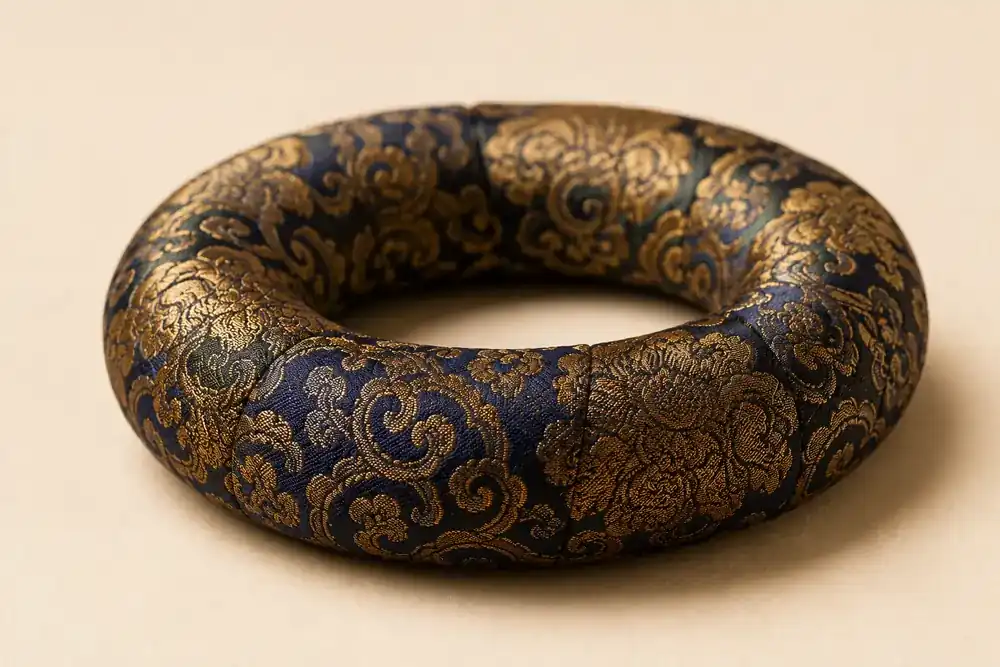
The cushion in every box is a brocade ring with filling inside, and the filling is why it never goes under a tap: water soaks in fast and leaves over days, taking the shape of the ring with it. A barely damp cloth, worked over the mark then blotted dry, is as far as this goes. The mallet is a separate conversation, on our mallet page: leather dry, out of direct sun, a wipe with a soft cloth now and then.
Bathrooms deliver steam. Everywhere else is fine, an open shelf, a desk, a nightstand. The one storage habit worth naming is shutting a bowl into a plastic bag or sealed box while it is still slightly damp, because that moisture has nowhere to go.
The bowls in the best condition are the ones being played. If you are still building that habit, start with the singing bowl meditation guide; if you are still choosing, the complete set arrives with bowl, cushion and mallet matched in one box.
Average rating across 105 verified purchases of the 3.5 to 6.7 in bowls, whose darkened wall is the finish those buyers are rating
— Verified buyer feedback, verified order history, 2026
Singing bowl cleaning questions, answered plainly
Can I use metal polish on my singing bowl?
Not on a darkened bowl. Metal polish is built to take tarnish off bright brass, and it cannot tell tarnish apart from the darkening applied at the workshop. One pass lightens the wall unevenly and lifts gold out of the engraved lines.
How do I get a white ring or a water stain out of the inside?
Wipe it with a soft cloth dampened with warm water and one drop of mild dish soap, then dry it at once. If the mark survives that, it is mineral deposit from hard water rather than dirt: leave it in place, since removing it takes an acid or an abrasive and both attack the finish.
Can I put water in the bowl to play it?
Yes, and a shallow layer changes the tone and makes the surface ripple while it sings. The rule is what happens next: tip it out, dry the inside straight away, and leave the bowl in open air before it goes back on its cushion. Water left standing overnight is what leaves rings.
My bowl has an uneven finish. Is that dirt I can clean off?
No, and you would not want it gone. On a hand-worked wall the darkening and the hammer marks fall differently on every piece, which is what gives your bowl its own face and its own voice. It is the signature of hand finishing rather than a mark of dirt, so leave it and let it deepen with use.
Unsure whether the mark on your bowl is dirt or finish? Send us a photo, a real person answers. If the bowl is new and simply not what you hoped for, the 30-day money-back guarantee beats any cleaning method, and other owners describe what arrived on our reviews page.

Mira Chandran · Sound practitioner & product lead at Nadam
Mira has been leading small-group sound baths for years. She plays every size Nadam sells — strike tone, rim singing, sustain, how the bowl sits on its cushion — before that model earns a place in the catalog.