
· Mira Chandran
Singing Bowl Notes and Chakras: Which Bowl Plays Which Note
Search for singing bowl notes and you land on charts: seven notes, seven chakras, seven colours, and a bowl to buy for each. Some of that is a tradition with real roots in how sound baths are taught; some of it is a spreadsheet. This guide separates the two for the instrument we actually sell, a hammered brass bowl, and answers the question in the title the only way it can be: tuner in one hand, bowl resting on the other. I play every diameter Nadam sells before it earns a listing, and the note is never the same twice.
If the physics of a hammered wall is new to you, our comparison of hand-hammered vs machine-made singing bowls explains where the overtones come from. This article picks up from there.
The chakra chart: seven notes for seven centres
| Chakra, in the tradition | Where it is placed | Note, in the convention |
|---|---|---|
| Root (Muladhara) | Base of the spine | C |
| Sacral (Svadhisthana) | Lower belly | D |
| Solar plexus (Manipura) | Upper belly | E |
| Heart (Anahata) | Centre of the chest | F |
| Throat (Vishuddha) | Throat | G |
| Third eye (Ajna) | Between the brows | A |
| Crown (Sahasrara) | Top of the head | B |
Two things to hold at once. The chakra system is a tradition — a map of the body that yoga and meditation practice has carried for a very long time — and the note assignment is a convention layered onto it by modern sound work. Neither is a measurement. Nothing in the chart says what a bowl will do to a person, and we make no such claim; our position on what a bowl can and cannot be said to do is set out in singing bowl benefits. If you are managing a health condition, talk to a healthcare professional. A bowl is an instrument.
What the chart is good for is structure: a direction for a session, low to high, and seven places to rest attention in a fixed order. Read it that way and it earns its place on the wall.
What a hammered brass bowl actually plays
A singing bowl is a standing bell. Its sound comes from the walls flexing in and out, and the walls can flex in more than one pattern. The simplest pattern is the one that decides the note you would name: the rim moves in and out at four places and stays still at four others between them, like a circle being squeezed into an oval and back, hundreds of times a second.
A 2011 study of Tibetan singing bowls in the journal Nonlinearity laid this out on the bench. Tapping the bowl excites a number of those vibration patterns together; rubbing the rim with a leather mallet excites mainly the lowest one, and its harmonics lock in with it. The same study noted that because a hand-made bowl is never perfectly symmetrical, that lowest pattern splits into two very close pitches that beat against each other — the slow pulse you can hear inside a long hum.
Still points around the rim in a singing bowl's fundamental vibration mode, the mode that rim singing brings forward; a strike excites several modes at once
The hammer marks that give every Nadam bowl its texture also leave the wall a shade thicker here and thinner there, and those differences are what the overtones are made of.
Why we do not print a note on the box
The same study gives the rule of thumb in its simplest model: the fundamental climbs as the wall gets thicker, and it drops with the square of the bowl's radius. Width pulls the note down hard; wall thickness pushes it back up. On a hammered bowl, thickness is whatever the hammer left behind, dimple by dimple, and it differs from one bowl to the next even at the same diameter.
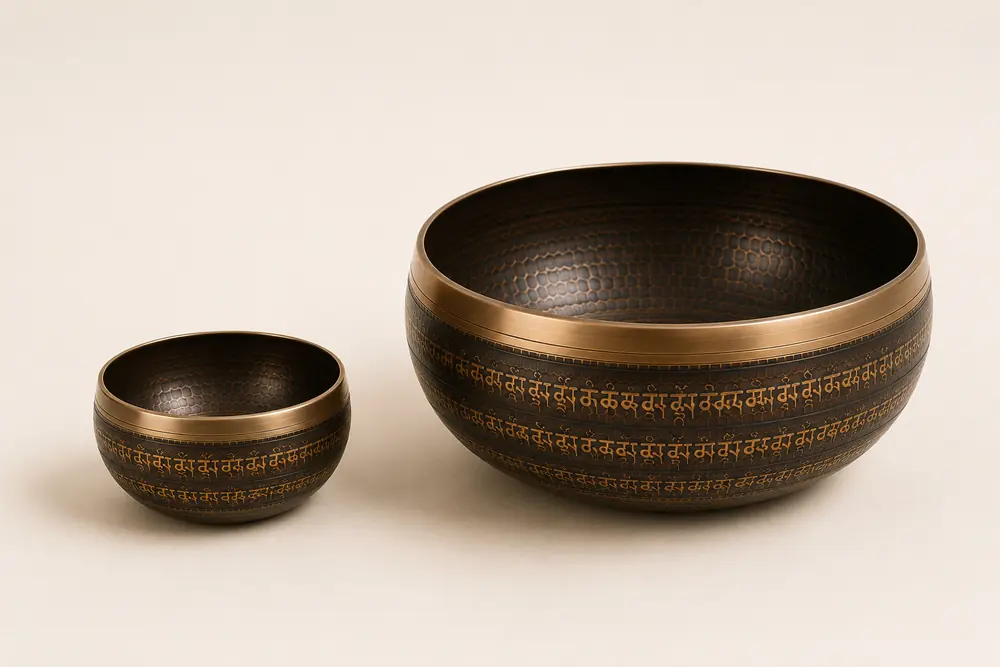
That is why you will not find a frequency chart on any Nadam page: no chart could hold for the bowl arriving at your door, and a spec nobody measured is decoration. What we check is the part that matters more. Every model is played before it earns a listing for a clean fundamental at every strike pressure, a hum that catches within a few rim circles, and a fade that tapers instead of cutting off. The letter on the tuner is yours to discover; the voice behind it is what we checked.
How to find your singing bowl's note
1. Set the bowl free. Quiet room, bowl on a flat, open palm or on its cushion. Fingers curled around the wall mute exactly the movement you want to read.
2. Start the hum. Slow circles, even pressure, the leather end of the mallet if you have one. If the hum still comes and goes, our guide on how to use a singing bowl covers the knack in a single sitting.
3. Read, then wait. Hold the tuner near the rim and let the reading settle. Expect it to sit between two letters: hammered brass is not tuned to any scale. Take the nearest letter and remember how far sharp or flat it sits.
4. Strike once and compare. The tuner may jump between two or three readings before it settles: those are the extra patterns a strike excites, the overtones you hear.
| What the tuner shows | What it means |
|---|---|
| The needle sits between two letters | Normal for hammered brass. Take the nearest letter and note the offset |
| The reading jumps on a strike, settles on a hum | A strike excites several patterns; the hum brings the lowest one forward |
| Two readings a hair apart during a long hum | The split fundamental of a bowl that is not perfectly symmetrical, heard as a slow beat |
| The reading drops after you add water | Extra mass on the walls lowers the fundamental; it comes back once the bowl is emptied and dried |
Write the letter down and keep it with the bowl: it came from the instrument in your hand, and that is the figure to trust.
Which size sits where: diameter and pitch
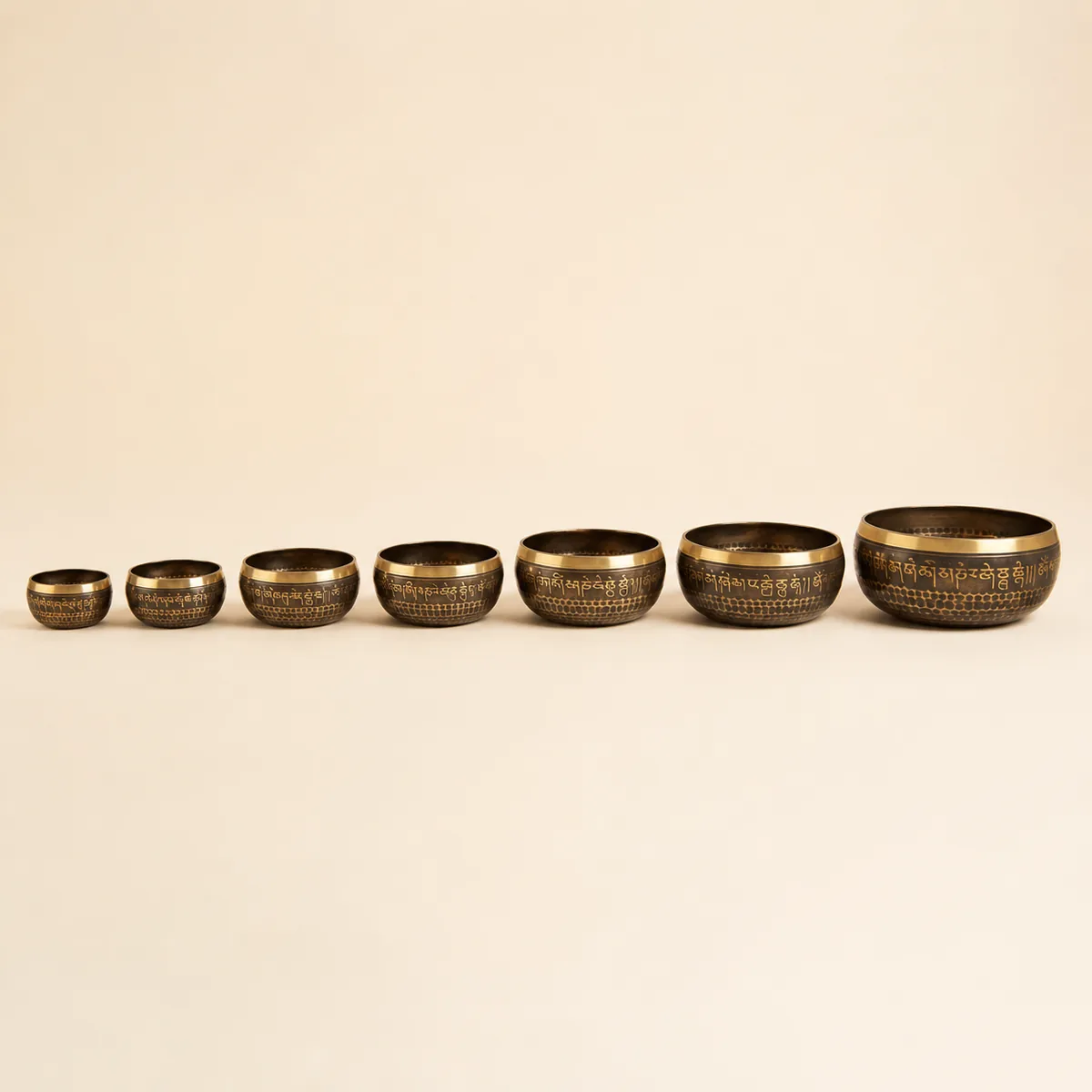
The widest bowl in the range is 2.2 times the diameter of the smallest, so seven sizes cover a great deal of pitch: same brass, same hammer work, same engraved mantras, and a voice that moves from a bright desk note to a slow hum as the diameter climbs.
The seven diameters we sell (8 to 17 cm): the wider the bowl, the lower its fundamental sits
— Nadam dimension sheet, 2026
If your real question is which size, large vs small singing bowl compares the three bands on voice, sustain, handling and price. Pick the band for the job, then let the tuner tell you the letter.
Using the chakra sequence with one bowl

Here is the version I use in small sessions. Sit with the bowl on its cushion, strike once, and rest your attention at the base of the spine until the tone is completely gone. Strike again for the lower belly; again for the centre of the chest; and so on up to the crown, seven strikes in all, each fade followed to the end. It fits inside the strike phase of the 20-minute sound bath at home sequence, and it gives a beginner a reason to keep the mind in one place per tone.
What the bowl brings is a tone that moves: the fundamental stays put while the overtones swell and fade at their own pace, and the beat inside a long hum keeps the sound from going flat. Over seven fades, that movement is what attention holds on to.
Average rating across 105 verified purchases of the 3.5 to 6.7 in bowls
— Verified buyer feedback, verified order history, 2026
None of this needs seven bowls or a certificate. It needs one bowl you will actually pick up: the Nadam bowl that gets played is the one within reach.
Adding a second bowl, and what the mallet changes
A second bowl from the same band would sit close to the first. Jump a band — a 3.1 or 3.5 inch bowl beside a 5.9 or 6.7 — and you have the two ends of the range, high and low, base and crown. The singing bowl set lets you choose the diameter, and every size ships with its cushion and its own mallet.
The mallet is the other lever. Wood on brass gives the brightest strike and the most audible overtones; a stitched leather head cushions the first contact and lets the fundamental come forward, which helps when reading a tuner or holding a long hum. Our leather mallets come in three sizes matched to the diameters — small for the 3.1 to 4.3 inch bowls, medium as the all-rounder, and the large head for the 5.9 and 6.7 inch bowls and their deeper voices — from $14.95.
Singing bowl notes and chakras, answered plainly
What note is a Tibetan singing bowl?
There is no single answer for hammered brass. Each bowl sounds a fundamental with overtones above it, and that fundamental depends on the diameter and on how thick the hammer left the wall, so two bowls of the same size do not share a note. Wider bowls sit lower. To learn yours, circle the rim until the hum is steady and read a chromatic tuner.
Do I need seven bowls for the seven chakras?
No. The chart is a sequence of seven places to rest your attention, and one bowl carries it: seven strikes, one per centre, each fade followed to the end. A second bowl from a different size band adds a genuinely different voice, high beside low.
Which note goes with the heart chakra?
F, in the convention commonly taught in sound-bath settings: C for the root, D sacral, E solar plexus, F heart, G throat, A third eye, B crown. That mapping is a tradition rather than a measurement. Nothing about it is a health claim; if you are managing a health condition, talk to a healthcare professional.
Does the note change if I put water in the bowl?
Yes, it drops. The walls carry the weight of the water as they flex, and extra mass slows a vibration down, so a tuner reads lower the more you pour in, and the ring gets shorter. Tip the water out, dry the bowl, and it returns to the note you measured dry.
Every Nadam Tibetan singing bowl ships free with its mallet and cushion, from $39.95, backed by a 30-day money-back guarantee — so the first thing you do when it arrives can be to hold a tuner up to it and learn its letter.

Mira Chandran · Sound practitioner & product lead at Nadam
Mira has been leading small-group sound baths for years. She plays every size Nadam sells — strike tone, rim singing, sustain, how the bowl sits on its cushion — before that model earns a place in the catalog.