
· Mira Chandran
Singing Bowl With Water: What It Changes
Somewhere between the first strike and the tenth, most owners try it: a splash of water in the bowl, to see what happens. What happens is worth the two minutes. The note drops, the tail shortens, and a flat surface turns into something that moves while you play — a fine tremble first, then rings, then droplets skipping across the top. None of it is mystical, all of it is repeatable, and a folded towel is the whole of the preparation.
This guide covers what the water changes, on any of the seven diameters we sell. If a steady hum still comes and goes on a dry bowl, start with how to use a singing bowl — water rewards a hum you can already hold.
What a shallow layer does to the note
The sound of a singing bowl lives in its walls. Strike the rim or circle it and those walls flex in and out in tiny waves, hundreds of times a second, and the air around them carries the result to your ear. Rest the bowl on a curled hand and you mute it, because your fingers are damping those walls. Pour water in and you are doing something related but far gentler: loading the walls rather than stopping them.
A wine glass makes the same point on a kitchen table. Run a wet finger around an empty one and you get a high, thin note; fill it and the note walks downward as the level climbs. A bowl behaves the same way, in a lower register. Nothing goes out of tune and nothing is harmed — the bowl simply speaks in a different voice for as long as the water is in it, and returns to the note you know the moment you empty it.
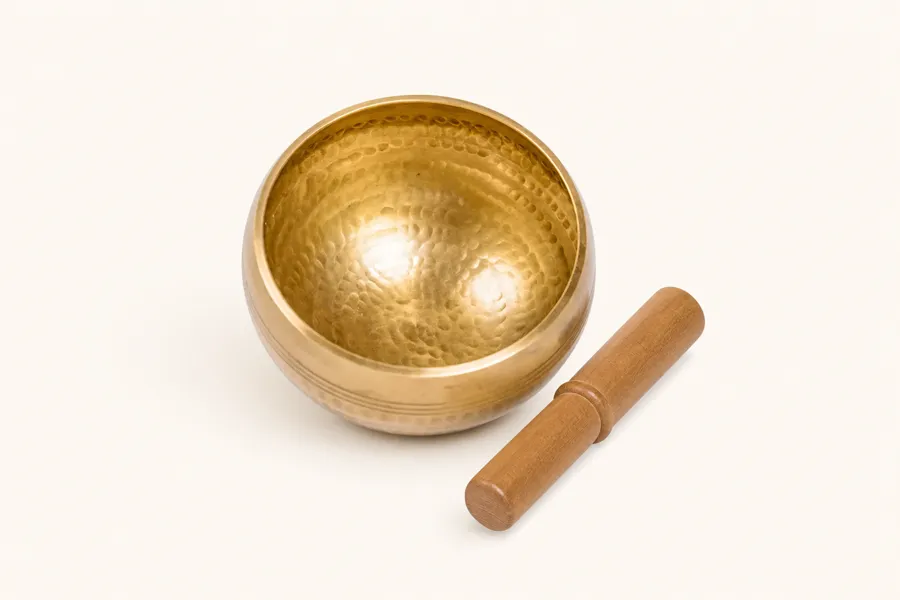
The second change catches people out more than the first. A dry Nadam bowl holds a long, gradual fade, and that tapering tail is one of the things every model is played for before it earns a listing. Add water and the tail gets shorter. Nothing is broken: the water is taking a share of the energy, and you can watch it take that share.
Why the surface ripples, and why droplets jump off it
This is the part people film, and it has been studied properly. A 2011 paper in the journal Nonlinearity put a fluid-filled Tibetan bowl on a bench and worked through exactly what the surface does as the driving gets stronger. Striking or rubbing the bowl sets the walls vibrating, and the walls set waves running at the fluid surface; push harder and those waves reorganise into the standing ripple pattern the authors call edge-induced Faraday waves. Harder still and the surface fractures, throwing off drops.
Year a study of fluid-filled Tibetan singing bowls described the surface ripples as edge-induced Faraday waves, and droplets thrown off by the surface breaking up
The best detail in that paper is what the drops do next. Rather than falling straight back in, they can sit on the moving surface, bounce on it, or skid across it — water refusing, for a second or two, to rejoin the water it came from. A bright light helps you catch it.
The ripples always arrive before the droplets, and both arrive because you kept going. That makes the surface a literal display of how evenly you are circling: hold your pressure and the rings sit still; wobble and the pattern scrambles.
How far to fill it, and what the level changes
There is no correct level, only trade-offs, and they are easy to hear. Work up in small pours and stop wherever the bowl sounds like something you want to sit with.
| How full | What you hear | What you see |
|---|---|---|
| A film across the base | Almost the dry note, with a slightly shorter tail | A fine tremble; rings need a strong, steady hum |
| Base comfortably covered | A clear step down in pitch, tail noticeably shorter | The most reliable ring pattern, and where droplets start |
| Around a third full | Lower and rounder, the hum takes longer to build | Big slow ripples, droplets that carry further |
| Half full and beyond | Low and short; the bowl wants real pressure to start | Surface close to the rim, so spills become the deciding factor |
That last row is where most first attempts go wrong. A full bowl looks like it should do more, and it does less: the hum is harder to start, the note dies quickly, and the water sits a finger's width from the rim. Under-filling is the recoverable mistake.
Strike or rim circle: which one the water answers
Both gestures set the walls moving, and both put waves on the water. The difference is duration. Strike a water bowl and you get one satisfying shudder across the surface, lovely in itself and over in a second. Circle the rim and you are pushing continuously, so the surface can climb through its stages: tremble, rings, break-up.
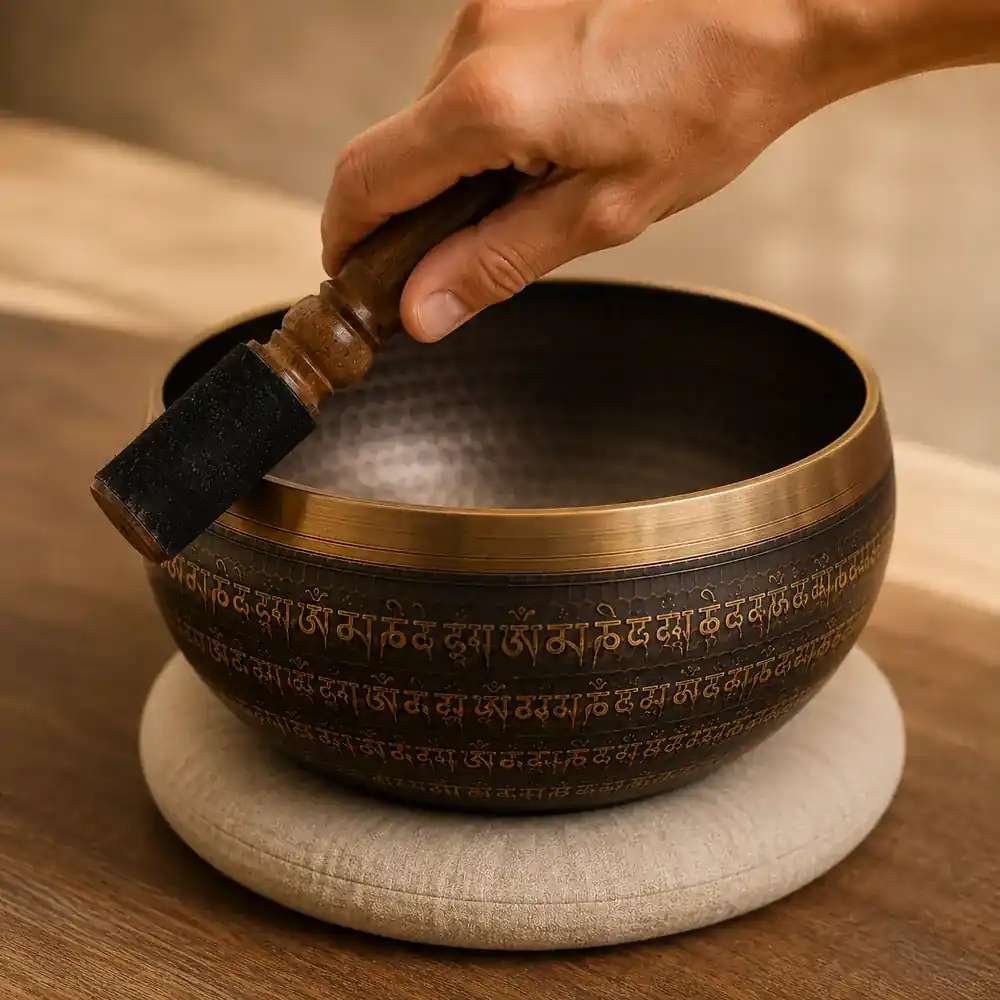
Water also raises the entry cost of the hum. The walls are carrying more, so they take longer to get going, and the answer is the one that solves most rim problems: more pressure into the rim, slower laps. The mallet earns its keep here — a stitched leather head grips more forgivingly than bare wood, which counts when the bowl is already asking for a firmer hand. Our mallet size guide sets out which head suits which diameter.
Which bowl size takes water best
The seven diameters we sell (8 to 17 cm). The wider the bowl, the more surface the ripple pattern has to appear on
— Nadam dimension sheet, 2026
Diameter decides both the voice and the handling, exactly as it does on a dry bowl. Our comparison of large and small singing bowls walks through what each diameter sounds like before any water is involved, and that ranking holds once you add some.
What changes is the handling. On a small bowl the water sits close to the rim from the first pour, and a small bowl is usually held rather than set down. Put it on a firm surface for water work; the wider sizes are played on their cushion anyway.
Setting up, and drying it afterwards
The cushion is the thing to protect. Every bowl arrives with a brocade cushion, and a brocade ring with filling inside takes water in fast and gives it back over days. Lift it clear, put a folded towel where it was, and the bowl sits just as steadily. The bowl, cushion and mallet set is built to be played together, and this is the one session where the three separate.
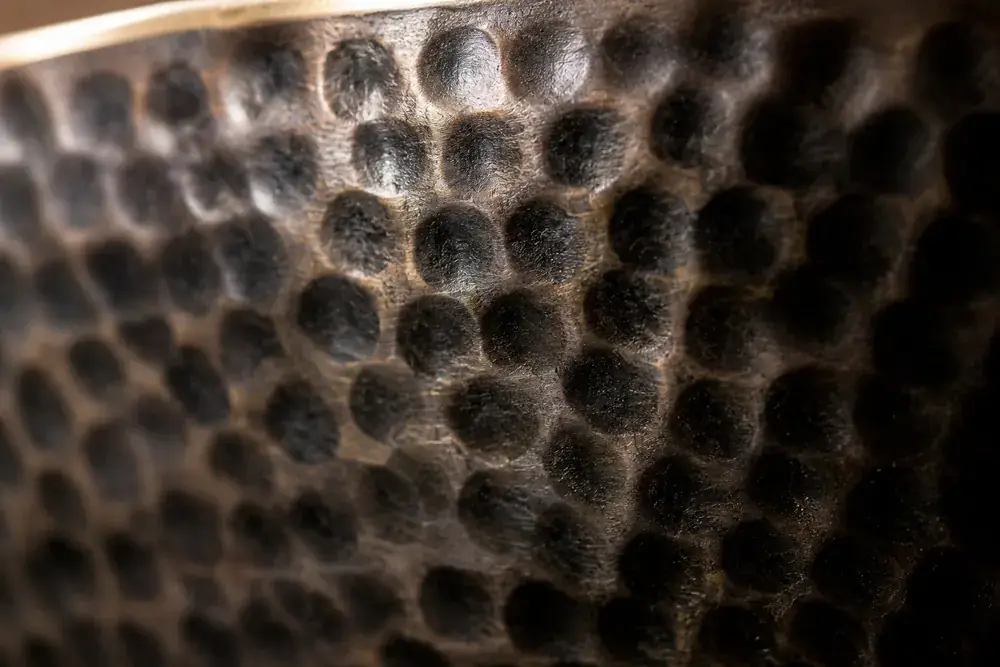
Drying is short and non-negotiable: empty it, wipe the inside, then leave it in the air a while before it goes anywhere enclosed. Water left standing in the engraved lines or under the base is what dries into rings, and the hammered dimples give it places to hide. Our guide to cleaning a singing bowl without stripping the patina covers what to do if a mark appears.
Where a water bowl fits in a session
The two do different jobs. When a bowl is marking time — one strike to open ten quiet minutes, one to close them — that long tapering fade is the whole mechanism, and water shortens exactly that. The routines in our singing bowl meditation guide are built on the dry note for that reason.
Water earns its place elsewhere. It is the version to bring out when someone new is in the room: a surface that ripples and throws drops explains an instrument faster than any description of it, and it is the most direct way to see that the walls really are moving.
Average rating across 105 verified purchases of the 3.5 to 6.7 in bowls — the diameters with the most surface for water work
— Verified buyer feedback, verified order history, 2026
On what the sound does for you, our position is set out in full in singing bowl benefits, and water changes none of it. A bowl with water in it makes a different sound and shows you a lovely piece of physics. Charged water, tuned frequencies, water that carries an effect somewhere: those are claims we make no part of, here or anywhere else.
Singing bowl and water questions, answered plainly
Does water damage a singing bowl?
Playing with water in the bowl does not damage it. Leaving the water in it does. Tip it out when you finish, dry the inside straight away, then leave the bowl in open air before it goes back on its cushion.
Why does my bowl sound lower with water in it?
The walls make the sound, and the water is riding on them. Every drop is extra mass those walls carry as they flex, and mass slows a vibration down. It is the same reason a wine glass drops in pitch as you fill it.
How do I get the water to ripple or jump?
Rim singing rather than striking. A strike is one push that fades; circling the rim keeps feeding the walls, so the surface has time to build. Rings appear first, and pushing the hum louder breaks that pattern up into droplets.
How much water should I put in?
Start with barely enough to cover the base and add from there. A thin layer moves the most visibly for the least mess. The fuller the bowl, the lower and shorter it sounds, and the closer the surface sits to the rim your mallet is pressing on.
Every Nadam Tibetan singing bowl ships free with its mallet and cushion, from $39.95, backed by a 30-day money-back guarantee — so the first bowl you try this on can be the one you keep.

Mira Chandran · Sound practitioner & product lead at Nadam
Mira has been leading small-group sound baths for years. She plays every size Nadam sells — strike tone, rim singing, sustain, how the bowl sits on its cushion — before that model earns a place in the catalog.